Why ChatGPT Recommends Your Competitors (And Not You)
You type your business into ChatGPT.
Not your name — that’s too easy. You ask it the question a real buyer would ask: “Who are the best [your service] businesses in [your city]?” Or “Who would you recommend for [the problem you solve]?” Or “Which [your category] actually delivers results?”
The same competitors come up. Again. Possibly in the same order.
Your business? Nowhere.
It’s a strange kind of invisibility. Your website is live. You rank for a few reasonable keywords. Your Google Business Profile is complete. By the old measures, you’re doing fine.
But the old measures are no longer the only ones that matter.
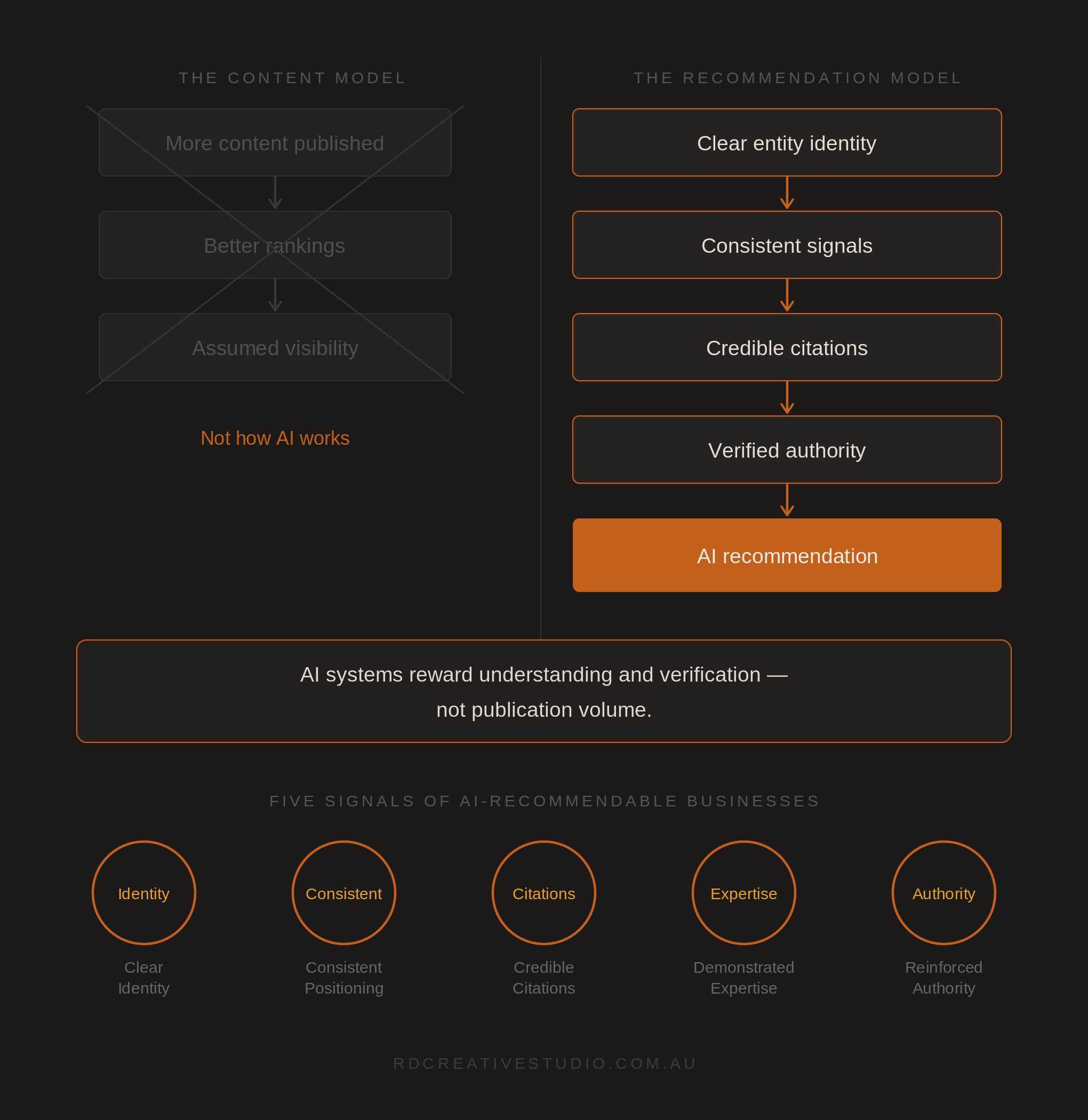
Why AI Recommends Some Businesses And Ignores Others
The New Visibility Layer Most Businesses Miss
For fifteen years, visibility meant one thing: ranking. Content, keywords, links, position. The rules were understood and the scoreboard was public.
That model still exists. But it’s no longer complete.
AI-powered search — ChatGPT, Perplexity, Claude, Gemini, Google’s AI Overviews — has introduced a second scoreboard. These systems don’t serve a list of results for the user to evaluate. They synthesise a direct answer and surface the businesses, experts, and services they consider credible. The user receives a recommendation and often acts on it without ever visiting a search results page.
Ranking and recommendation have quietly become different outcomes.
Traditional Search Visibility | AI Recommendation Visibility |
Optimise for keyword position | Be recognised as a credible entity |
Win a click from a results list | Be included in a direct recommendation |
Measured by traffic and rankings | Measured by presence in AI-generated answers |
Driven by content quantity and backlinks | Driven by entity clarity and citation authority |
User evaluates options | AI evaluates options on the user’s behalf |
Visible if you rank | Visible only if AI systems trust you |
Most businesses have invested in one of these. The other is running in the background — with consequences they haven’t noticed yet.
The Biggest Myth In AI Discoverability
“We Just Need More Content”
This is the most expensive assumption in AI discoverability right now.
It’s understandable. Content has been the primary lever in search visibility for over a decade. When something isn’t working, you publish more. When competitors are outranking you, you check their output volume and respond in kind.
The problem is that AI recommendation systems don’t work this way.
We regularly encounter businesses publishing four, six, eight pieces of content a month — and still absent from AI-generated answers in their category. Meanwhile, there are businesses with modest content libraries that appear consistently across ChatGPT, Perplexity, and Google AI Overviews. The difference isn’t volume. It’s legibility.
“Machines don’t recommend businesses because they publish the most. They recommend businesses they understand the best.”
The question AI systems are answering when they decide whether to surface your business isn’t ‘has this business published recently?’ It’s ‘do I understand this business well enough to confidently recommend it?’
That’s a fundamentally different problem to solve.
What AI Systems Actually Need To Understand
AI recommendation systems are trying to answer five questions about your business. If they can’t answer them clearly, they default to the businesses they can.
- Who are you? A clearly defined business entity, not an ambiguous collection of services.
- What do you do? Specific enough to match intent, not broad enough to mean everything.
- Who do you serve? The audience, industry, or geography you’re associated with.
- Where do you operate? Physical, regional, national, or global — and consistently stated.
- What are you known for? The subject area, expertise, or perspective you demonstrably own.
When these answers are strong and consistent across your web presence, AI systems can confidently include you. When they’re weak or conflicting, you’re omitted — not penalised, just passed over.
Weak Entity Signal | Strong Entity Signal |
Services page with 11 unrelated offerings | Clear positioning around 2-3 connected capabilities |
“We help businesses grow” | “We build AI-ready marketing infrastructure for service businesses” |
Different descriptions across website, LinkedIn, and directories | Consistent language and positioning across every touchpoint |
No stated geography | Clear location signals and service area defined |
Generic blog content on broad topics | Original perspectives tied to a specific subject area |
Unnamed team | Named practitioners with demonstrated credentials |
The gap between these columns is where most businesses are losing AI recommendation ground without knowing it.
Citation Architecture: The Hidden Layer Behind Recommendations
If entity clarity is what gets you on the shortlist, citation architecture is what gets you selected.
Citation architecture refers to the pattern of credible third-party references that confirm what your business claims about itself. It’s how AI systems verify that you are who you say you are.
This is the component most businesses have never thought about deliberately. They’ve accumulated some citations organically — a directory listing here, a media mention there — but without intention. That’s not the same as having citation architecture.
Structured citation architecture looks like:
- Consistent mentions in industry directories and professional bodies
- References in credible media, even at a regional or trade level
- Podcast appearances, panel contributions, or speaking engagements
- Case studies and client references that contextualise your expertise
- LinkedIn authority signals from named practitioners
- Partner references and professional network mentions
- Local data consistency — name, address, phone number matching across every source
“AI behaves less like a search engine and more like a cautious researcher.”
A cautious researcher doesn’t take your word for it. They check your references. They look for corroboration. They notice when sources contradict each other. And when they can’t verify a claim, they don’t include it — they move to the next candidate who’s easier to confirm.
The businesses appearing in AI answers right now have, in most cases, built this corroboration layer — often without explicitly calling it that. The compound effect of that activity is now being read as authority.
Why Inconsistency Makes You Invisible
Here’s something AI systems are surprisingly good at: noticing when signals don’t add up.
A business that describes its services differently on its website versus its LinkedIn profile creates a discrepancy. A business that lists one location on Google Business Profile and another in a directory introduces doubt. A business whose founding date, team size, or core offering changes across sources sends a signal that AI systems read as noise — and noise is resolved by exclusion.
Inconsistency across your digital presence doesn’t just reduce confidence. It actively undermines it. Because AI systems aren’t looking for reasons to include you. They’re looking for reasons to trust you. And a presence that contradicts itself is a presence that hasn’t earned that trust.
This is often where businesses are surprised. They’ve never deliberately created conflicting signals — things have just evolved. A rebrand in 2022. A service line that got retired but the page stayed live. An old press release with a different positioning.
None of these feel significant individually. Collectively, they’re eroding machine confidence in ways that don’t show up in your analytics.
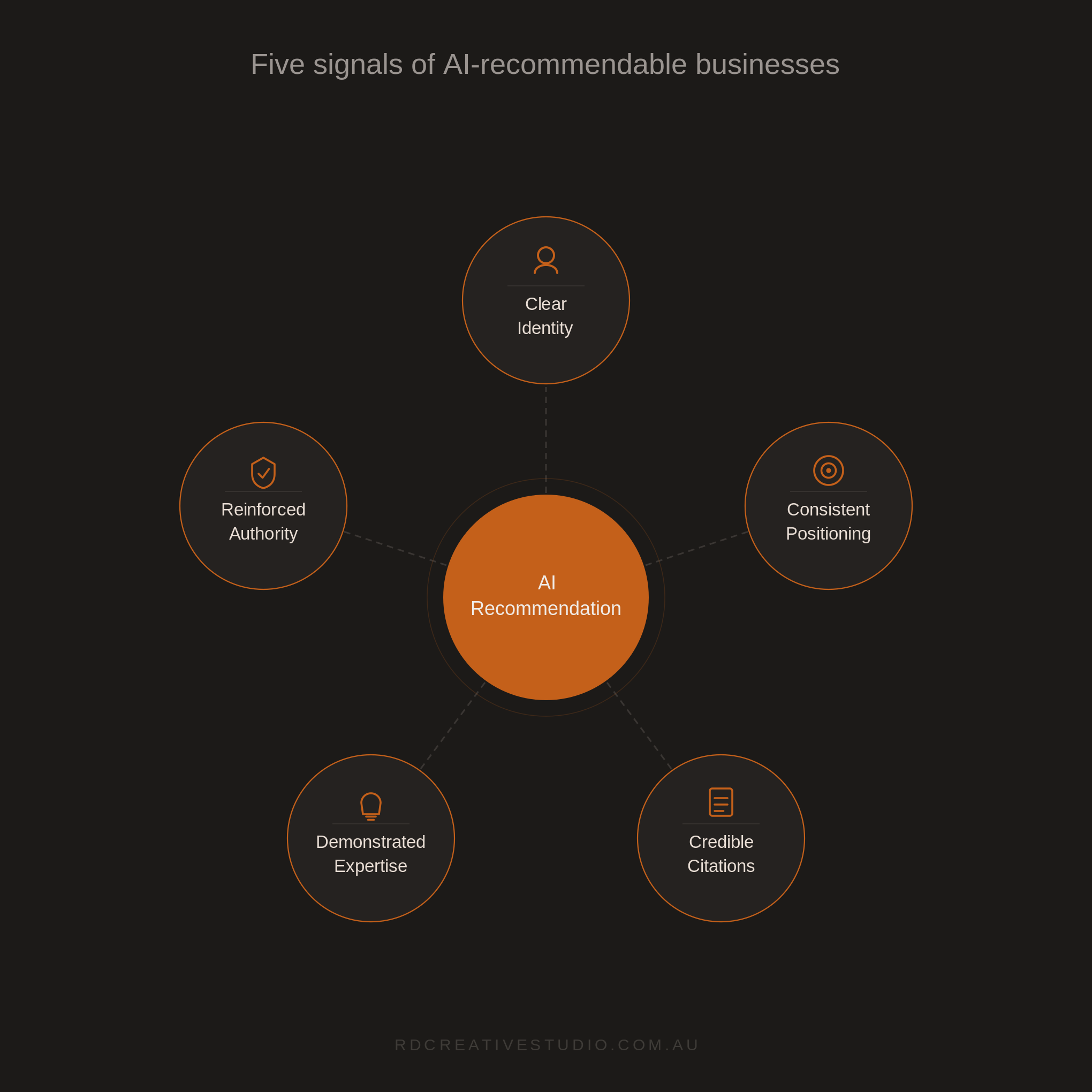
The Five Signals Of AI-Recommendable Businesses
After mapping how AI systems surface businesses across categories, five signals consistently separate those that appear from those that don’t.
1. Clear Identity
The business has a defined entity — a specific name, category, positioning, and audience — stated consistently everywhere it appears. There’s no ambiguity about what it is or who it’s for.
Example: A business that appears in AI answers as “a brand strategy consultancy for professional services firms” rather than “a creative agency that helps businesses grow.”
2. Consistent Positioning
The same message, tone, and service framing appears across the website, social profiles, directories, bios, and third-party mentions. AI systems read consistency as intentionality — and intentionality as credibility.
Example: Core service descriptions that use the same language on the homepage, LinkedIn, and every directory listing.
3. Credible Citations
Third-party sources reference the business in context. Not just links — mentions. Industry directories, media outlets, podcast appearances, event listings, partner pages. The citations don’t need to be from major publications. They need to be from credible, contextually appropriate sources.
Example: A regional firm cited in a state Chamber of Commerce directory, a local business journal, and three professional body listings.
4. Demonstrated Expertise
The business has original, substantive content in a defined subject area — not broad opinions on everything, but depth on something specific. AI systems use this to assess whether a business genuinely owns a topic or is performing relevance.
Example: A series of interconnected articles on the same subject that reference each other, build a consistent argument, and are cited externally.
5. Reinforced Authority
Named individuals behind the business have their own credibility signals — published work, professional profiles, speaking history, or media mentions — that corroborate the business’s claimed expertise.
Example: A named founder or director with a LinkedIn profile that includes publications, endorsements, or event appearances.
The RD Recommendation Visibility Diagnostic
Use this as a first-pass assessment of where your business currently stands. Score each signal honestly out of 10.
Signal | What You’re Assessing | Your Score /10 |
Entity Clarity | How clearly and consistently is your business defined across all touchpoints? | / 10 |
Consistency | How uniform is your positioning, messaging, and service framing across the web? | / 10 |
Citation Depth | How many credible third-party sources reference your business in context? | / 10 |
Authority Signals | Do named people in your business have visible, credible external profiles? | / 10 |
AI Discoverability | If you run the test below right now, do you appear? In how many platforms? | / 10 |
Score interpretation:
- 40-50: Strong foundation. Focus on deepening citation architecture and topical content.
- 25-39: Moderate visibility. Entity clarity and consistency gaps are likely costing you recommendations.
- Under 25: Significant gaps. AI systems don’t have enough to work with — this needs structured attention before it compounds further.
A Test You Can Run Today
Before you do anything else, run this test. It takes ten minutes and will tell you more than any audit report.
Open each of the following:
- ChatGPT (chatgpt.com)
- Perplexity (perplexity.ai)
- Claude (claude.ai)
- Gemini (gemini.google.com)
In each one, ask the question your ideal client would ask. Something like: “Who are the leading [your service] in [your city or industry]?” or “Which [your category] would you recommend for [specific outcome]?”
Observe three things:
- Who appears — and how often across platforms?
- What sources are cited to support those recommendations?
- Whether your business appears at all — and if not, who is filling that space?
The businesses appearing repeatedly, across multiple AI platforms, with source citations that include directories, media mentions, and published content — those are the businesses that have, intentionally or not, built strong recommendation signals. That’s the benchmark. If you want a structured version of this, including how to read what the sources tell you about the gap, we’ve mapped the full picture in our companion piece on AI visibility for businesses.
The Shift From Ranking To Recognition
The conversation in most boardrooms and marketing meetings is still about ranking. Position one. Click-through rate. Domain authority. These are real metrics and they still matter.
But they’re measuring the old game.
The emerging game — already running, already compounding — is about recognition. Whether AI systems recognise your business as a credible entity. Whether they can verify your authority independently. Whether they trust you enough to stake a recommendation on you.
This shift doesn’t make content irrelevant. It makes content strategy more important, because the question changes from ‘how much are we publishing?’ to ‘what signal does our content create for a machine trying to determine our credibility?’
The businesses that will hold structural advantage in AI-mediated search aren’t the ones publishing the most. They’re the ones whose digital presence sends the clearest, most consistent, most corroborated signal of who they are and why they’re worth recommending.
“The businesses that win AI visibility won’t necessarily create the most content. They’ll create the clearest signal.”
Your competitors aren’t appearing in ChatGPT because they’ve gamed an algorithm. They’re appearing because — whether by design or good fortune — they’ve built a presence that machines can understand, verify, and trust.
That’s fixable. But only if you start treating it as the problem.

Not sure where your business currently sits?
We’ll map it out.