
Your Business Is Invisible to AI. Here’s What That’s Costing You.
Type your business name into Google. It shows up. Maybe you rank for a few decent terms. Your website is live, your Google Business Profile is active, and by the old measures, you’re doing fine.
Now open ChatGPT or Perplexity and ask: “What’s the best [your category] in [your city]?”
Your name probably won’t come up.
That gap between where you rank and whether AI systems know you exist is the new visibility problem. And most businesses don’t know they have it.
The Complete Picture
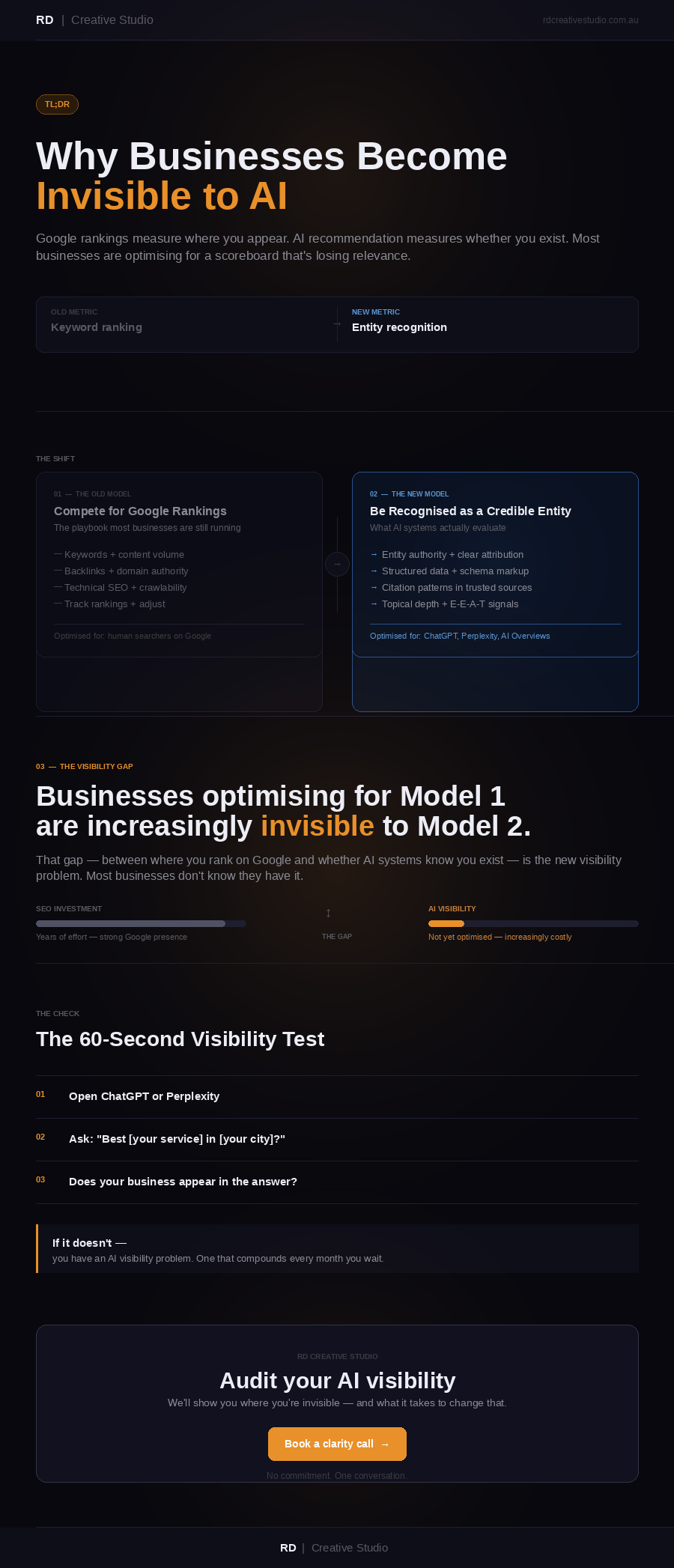
The Game Didn’t Just Change. The Scoreboard Changed.
For the last fifteen years, visibility meant one thing: ranking on Google. The rules were understood. Publish content, build links, optimise for keywords, monitor your position.
That model still matters. But it’s no longer the only model — and for a growing number of searches, it’s not even the primary one.
AI-powered answer engines — ChatGPT, Perplexity, Google’s AI Overviews, and others — are now handling the searches that used to end with a list of blue links. Instead of showing ten results and letting the user decide, they synthesise a direct answer, pull from sources they trust, and surface the businesses, experts, and services they consider credible.
The user never clicks through to compare. They just act on the recommendation.
If your business isn’t part of what AI systems consider credible, it doesn’t appear in that answer. Full stop.
How AI Systems Actually Decide What to Recommend
This is the part most businesses get wrong: they assume AI visibility is just an extension of their existing SEO work. Write more content. Use more keywords. Update the blog.
That’s not how it works.
AI systems don’t browse the web the way a user does. They build and retrieve from structured models of the world — models that identify entities (businesses, people, places, topics), assess their authority, and determine whether they’re worth surfacing in response to a question.
To be retrieved, your business needs to be legible to those models. That means several things working together:
Entity Clarity
AI systems need to confidently understand what your business is, what it does, who it serves, and where it operates. Ambiguous or inconsistent information across your website, directories, and third-party sources creates noise — and AI systems resolve noise by omitting.
Topical Authority
It’s not enough to have a page on a topic. AI systems assess whether a source genuinely owns a subject area. That means depth, consistency, and cross-referenced content that signals real expertise — not a few blog posts published in 2022.
E-E-A-T Signals
Experience, Expertise, Authoritativeness, and Trustworthiness remain the most important signals at play — and they’ve become more, not less, relevant in the AI era. Who’s behind the content? Are they cited elsewhere? Do credible third parties reference the business?
Structured Data
Schema markup is how you give AI systems clear, machine-readable information about your business. Without it, they’re interpreting your website like a document rather than a structured record. That interpretation introduces error. We include structured data as a standard component of our SEO and performance marketing work — because it’s no longer optional.
Citation Patterns
In the old model, backlinks were currency. In the AI model, citation patterns — who mentions you, in what context, on what kind of site — are how authority is confirmed. Being referenced by credible sources matters more than being linked to by high-DA domains.
None of this is revolutionary in isolation. The shift is in how these signals interact, and in what happens to businesses that optimise for only one of them.
The Visibility Gap Is Already Opening
This isn’t a future problem. It’s a present one.
Businesses that started building AI-era authority signals twelve months ago are already compounding. Their entity profiles are cleaner, their topical coverage is denser, and their citation patterns are more established. Every month that gap widens.
This mirrors what happened with domain authority in the early 2010s. Businesses that built it early found the gap nearly impossible for latecomers to close quickly. The same dynamic is in motion now — except the compounding is faster, because AI systems update their models more frequently than search engines historically updated their indexes.
There’s another dynamic worth naming: the zero-click shift.
For many search categories, users are no longer landing on websites at all. They’re getting answers directly from AI interfaces. Which means traffic alone is no longer a useful measure of visibility. A business can be ranking well on Google and still be entirely absent from the AI-mediated conversations that are driving purchasing decisions.
Ranking without AI visibility is increasingly like ranking in a directory no one reads anymore.
What Being AI-Visible Actually Requires
The businesses building AI visibility right now aren’t doing it by publishing more content. They’re making infrastructure decisions.
Specifically, they’re rethinking four things:
Website Structure
A website built for 2019 SEO may not be legible to AI systems in the right way. That means revisiting how content is organised, how entities are declared, and whether the site’s technical foundation supports structured data and schema — not as a plugin afterthought, but as a deliberate layer of communication. Our website design and development work now incorporates this from the ground up.
Authority Footprint
AI systems look beyond your website. Review platforms, industry publications, directories, and third-party mentions all contribute to your entity profile. A business that appears consistently and credibly across multiple sources signals authority in a way a well-optimised website alone can’t.
Content Architecture
Not content volume — content architecture. A dense, interconnected set of original perspectives on a specific subject area creates topical authority that isolated blog posts never will. This is how a business becomes a cited perspective rather than just a publisher. Our marketing systems are built around exactly this distinction.
Operational Visibility Signals
For local and service businesses, AI systems increasingly weight operational credibility — how consistently a business appears in structured local data, whether its NAP (name, address, phone) information is consistent across the web, and whether its business systems create the kind of consistent digital footprint that signals a real, active, credible operation.
Old Visibility Model | AI-Era Visibility Model |
|---|---|
Rank for keywords | Be recognised as a credible entity |
Backlink quantity | Citation quality and context |
Content volume | Topical depth and authority |
On-page SEO | Structured data and schema |
Google rankings | AI recommendation and retrieval |
Traffic as the metric | Presence in AI-mediated answers |
Keyword density | Semantic clarity and entity coherence |
The Question Most Businesses Are Asking Is Already Out of Date
Most businesses right now are asking: “How do I rank better for this keyword?”
It’s not a bad question. But it’s increasingly the wrong level of question.
The more important questions are: Does an AI system know my business exists? Does it understand what I do and who I serve? Would it recommend me in response to a relevant query — and if not, why not?
These questions lead to different work than traditional SEO. They require looking at your business’s digital presence from the perspective of a machine trying to determine credibility, not a user trying to navigate a list of results.
Most businesses haven’t made that shift yet. The ones that have are operating at a structural advantage that will only grow.
What to Do Before the Gap Becomes a Wall
The good news is that this is still early enough to move without panic.
The starting point isn’t a content sprint. It’s a visibility audit — an honest assessment of how AI systems currently see your business, where the gaps are, and what changes would have the highest impact first.
That usually means three areas of focus: cleaning up your entity signals (consistency across your web presence), building topical depth (original, interconnected content that signals genuine expertise), and ensuring your website gives AI systems the structured information they need to trust what they find.
The businesses that act on this now won’t just be better positioned when AI-mediated search becomes the norm. They’ll already be part of the infrastructure AI systems rely on.
That’s a fundamentally different position from trying to catch up later.


FAQs
What does it mean for a business to be “invisible to AI”?
It means that when someone asks an AI system — ChatGPT, Perplexity, Google’s AI Overviews — for a recommendation in your category, your business doesn’t appear. Not because you’re doing something wrong, but because AI systems haven’t been given enough credible, structured information to include you in their model of the world.
Is SEO still relevant in the age of AI search?
Yes — but its role has changed. Traditional SEO signals (content quality, site structure, authority) remain important because many AI systems are trained on or pull from indexed web content. The difference is that SEO alone is no longer sufficient. AI visibility requires additional signals: entity clarity, structured data, citation patterns, and topical depth. Think of SEO as the foundation, not the whole building.
How do AI systems like ChatGPT decide what businesses to recommend?
They synthesise information from multiple sources: their training data, real-time web access (where enabled), structured databases, and citation patterns across credible sites. Businesses that appear consistently, clearly, and credibly across these sources are more likely to be surfaced. There’s no single ranking factor — it’s the coherence of signals across the whole entity profile.
What is generative engine optimisation (GEO)?
GEO refers to the practice of optimising your business’s digital presence for AI-powered answer engines — systems that generate direct responses rather than lists of links. It includes structured data implementation, entity optimisation, authority building, and content architecture designed for machine extractability, not just human readability.
How is AI search visibility different from Google SEO?
Google SEO is primarily about ranking in a list of results. AI search visibility is about being selected as a trusted source for a direct answer. The former optimises for click-through; the latter optimises for inclusion in the answer itself. The technical requirements overlap but are not identical — and the strategic mindset is fundamentally different.