
The Only Five Pages Your Website Actually Needs to Rank
You can tell a lot about a business from the first ten seconds on their site.
Some websites feel like wandering into a messy storage shed where someone insisted everything was “important.” Others feel like walking into a clean workshop with just the tools that matter, hanging in the right places.
Guess which one Google prefers.
People often ask how many pages a website needs to rank. The answer is both simple and slightly annoying: fewer than you think. . .but more intentional than you’ve been told.
We have audited hundreds of sites across industries. Most are bloated. Or scattered. And strangely enough, the ones winning in search usually rely on the same small set of pages. Five, to be precise. That’s the Spartan way: A clean blade instead of a rusted arsenal.
Before we dive in, a quick reminder: if you are frightened of clarity, you will not like this article. Clarity reveals all the places you have been hiding.
Right. Let’s begin.
Why Fewer Pages Often Rank Better
It took us long to finally hammer this in, but the internet runs on comprehension. What we mean is that Google, for all its fancy algorithms, is still trying to understand what your site is about. If your pages contradict each other, or wander, or multiply like rabbits, Google treats you like background noise.
A tight structure tells Google, and humans, what you stand for. A cluttered structure says: “I’m not sure either.”
This is the reason lean websites usually outrank the giant Franken-sites stitched together by panicked business owners who keep adding pages to solve problems that start somewhere else. I know that sounds a little stern, but it is true. If your architecture is weak, everything else feels like patchwork.
So the goal is not more pages. The goal is the right pages doing the heavy lifting.
Below is the spine of almost every high-performing small or medium business site we’ve ever touched.
1. The Homepage: Your Relevance Anchor
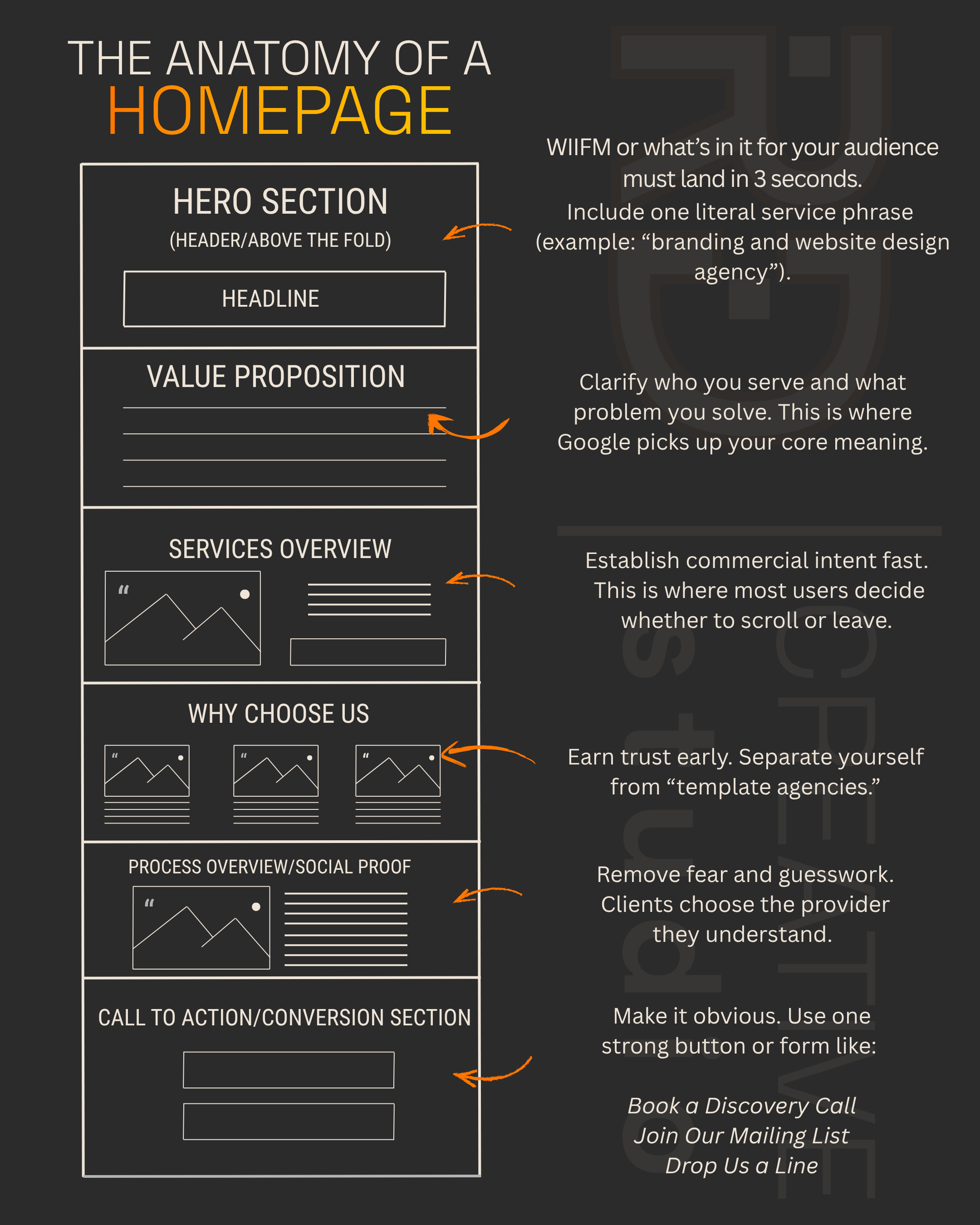
If your homepage feels like a polite shrug, nothing else on your website will save you.
A good homepage answers three questions within a single breath:
- Who are you
- What do you solve
- Why should anyone believe you
Not in a dramatic reveal nor in a “Journey of our Founders” kind of autobiography, mind you. Just clean, sharp truth that shows you understand your audience and their problem.
This is because Google crawls your homepage more than any other page. It uses it as a reference point for everything else you say. If the homepage is vague, or decorative, or coy, your SEO suffers. Humans bounce. Both hurt you.
Homepage essentials
- A clear value promise
- Primary service signals
- Internal links to your key pages
- Location relevance
- Proof someone actually trusts you
When your homepage is strong, everything becomes easier to rank. When it is weak, everything becomes harder. Vikings would call this the foundation stone.
2. The Services Page: Your Commercial Engine
This is the page where Google learns what you actually do. And this is where people decide whether they should stay or leave.
A lot of business owners mistakenly turn this into a gallery of buzzwords. “Innovative solutions.” “Tailored strategies.” “Digital excellence.” None of these phrases help you. They read like word salad.
Google wants explicit clarity. Humans want the same.
Your Services page should:
- Name the service in simple language
- Explain how it helps
- Share enough detail to reassure
- Guide people to take the next step
If you offer multiple services, cluster them neatly. What you don’t want is a labyrinth of mini-pages leading to nothing. The Services page is meant to be a map, not a maze.
This single page often carries the highest ranking potential. It attracts commercial intent keywords that lead to real enquiries, not the usual cold traffic that disappears after fifteen seconds.
3. The About Page: Your Human Credibility Signal
People underestimate this page. Google does not.
Google checks your About page for E-E-A-T signals: expertise, experience, authority, trust. You cannot rank meaningfully without them.
Visitors check this page for something even simpler. They want to know if you are a real person with real work behind you. Not a faceless template who hopes no one asks too many questions.
Your About page is where you stop being a pretty brand and become a trustworthy operator. It is also where you show the personality that separates you from everyone else using the same stock language.
Strong About pages include:
- A real name
- Real faces
- Credible experience
- A simple origin story
- Proof you know what you are doing
When an About page feels grounded, everything else on the site feels sturdier.
4. The Blog or Insights Page: Your Expertise Beacon
This is not a diary. This is not a dumping ground for half-baked announcements.
Your Blog or Insights page is where you build topical authority, which Google rewards. It signals that you have depth, not just a landing-page level of knowledge.
This page matters because it:
- creates long-tail SEO traffic
- earns AI Overview citations
- supports your main pages through internal links
- demonstrates real intellectual range
- builds trust at scale
People think blogging is optional. It is optional for people who do not want organic traffic.
For everyone else, it is essential.
5. The Contact Page: The Conversion Endpoint
Simple page. Important page.
Google checks your Contact page for:
- NAP consistency
- Location relevance
- Schema signals
- Proof you are a legitimate business
Humans check it for:
- whether contacting you will be painful
- whether they need to write an essay
- whether you will respond
A Contact page with too many fields feels like bureaucracy. A Contact page with too few feels unserious. Aim for two or three. Name, email, and one prompt. Nothing heroic.
This page is where the ranking work becomes revenue.
Without it, your SEO is just a hobby.
Optional Pages That Boost You Further (But Do Not Replace the Core Five)
Below is a simple table because this is where people start adding unnecessary fluff and then wonder why things slowed down.
Page Type | Worth Adding | Impact Level |
Case Studies | Yes | Very High |
Testimonials Page | Optional | Medium |
Location Pages | Yes if you serve multiple regions | High |
Portfolio | Yes for creatives | High |
FAQ Page | Good for schema | Medium |
Lead Magnet Landing Page | Yes if you plan to build a list | High |
Everything else trims into the “Probably Not” pile.

What You Don’t Need
You do not need:
- Twenty service pages that all say the same thing
- A blog with one post from 2021
- A “Vision, Mission, Values” section that reads like corporate oatmeal
- Fifty navigation tabs
- Anything you wrote because you felt guilty, not strategic
Clarity is king. Everything else is decoration.
How to Structure These Five Pages for Maximum SEO Strength
To gain rankings, you do not brute-force keywords. You design a structure that Google can climb.
Checklist
- Use natural, conversational headings
- Keep URLs clean
- Add internal links intentionally
- Put your strongest pages in the main navigation
- Add schema where it matters
- Load fast
- Avoid anything that feels like academic fluff
Search engines reward structure because structure helps machines think.
Humans reward structure because structure helps them feel safe.
You need both.
FAQs
What pages are essential for SEO
The Homepage, Services, About, Blog or Insights, and Contact page are the five that carry the most ranking impact.
Does page count affect SEO
More pages do not equal better rankings. Clear, authoritative pages are what matter.
Do I need a blog to rank
If you want sustainable organic traffic, yes. It is the simplest way to show ongoing expertise.
How many pages does a small business website need
Five core pages. Everything beyond that depends on your strategy, not your insecurity.
Is site structure important for ranking
Absolutely. Google and humans both punish confusion.
A Quiet Nudge Before You Go
If you want a site that ranks, converts, and feels like a grown-up brand, you do not need a hundred pages. You need five that carry weight.
If you want them built properly, with intelligence and intention, you know where to find me.
Let’s talk about your next move.
Drop Us a Line
Your email address will not be published. Required fields are marked *