Why Smart Business Owners Keep Talking Themselves Out of the Right Upgrade
What You Need to Know
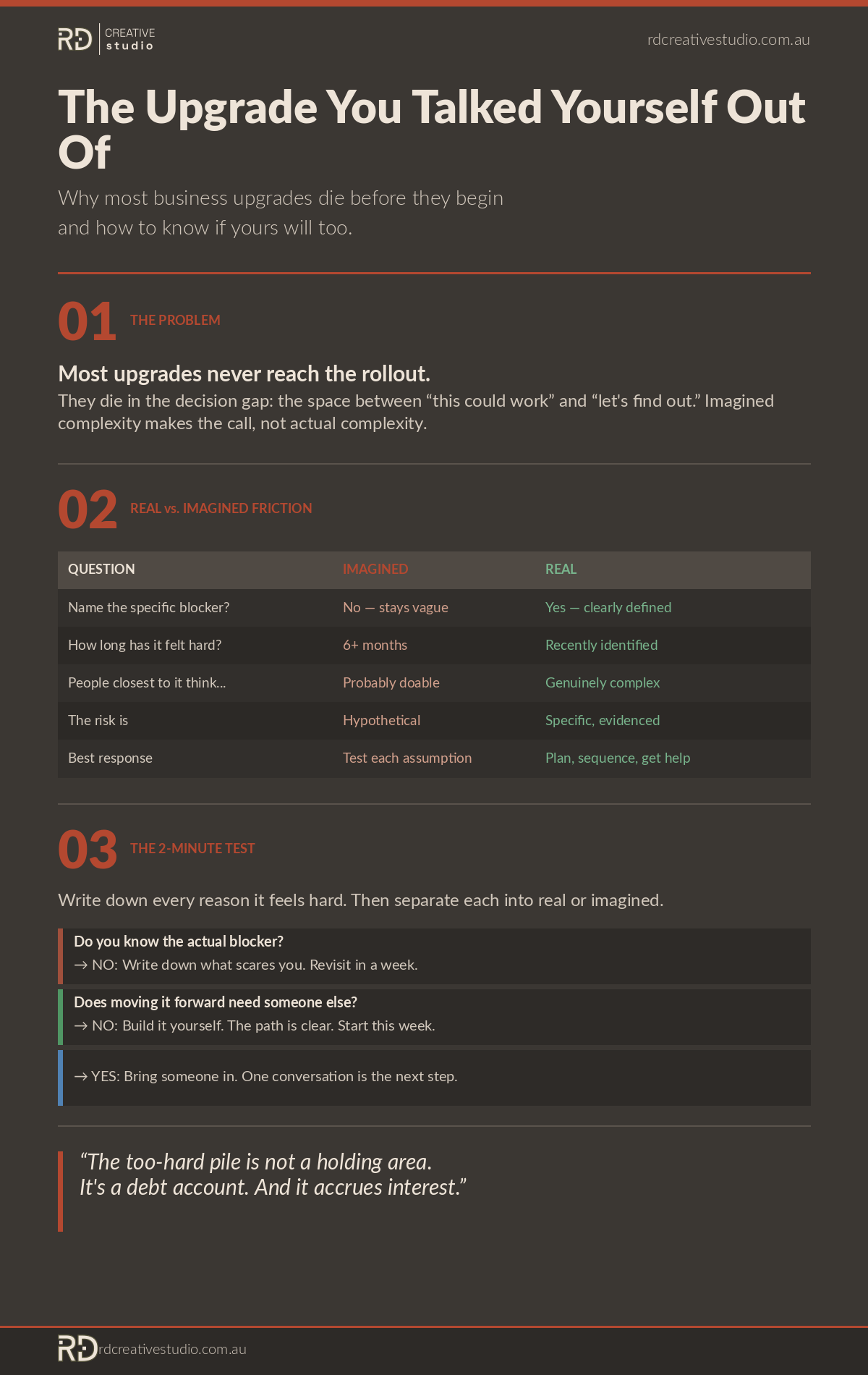
- Most business upgrades never reach the rollout. They die in the decision gap — the space between "this could work" and "let's find out."
- Imagined complexity feels like legitimate caution, but the tell is this: when you try to get specific about what's complex, the answer gets vague.
- Operational inertia compounds. A process that wastes two hours a week doesn't just waste 104 hours a year — it creates a context where everything takes longer.
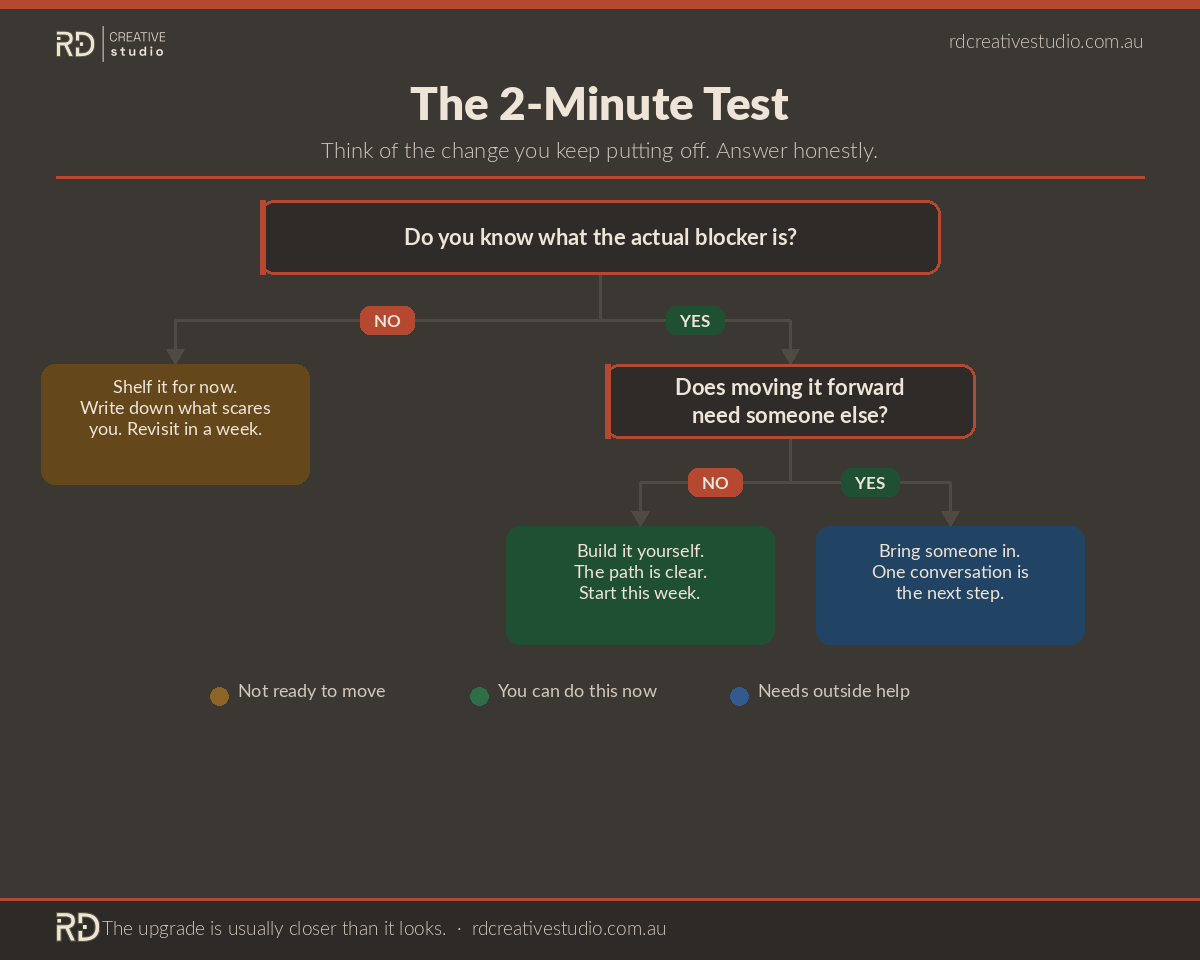
- The 2-Minute Test: Write down every reason a change feels hard, then mark each as real or imagined. For most people, the list collapses.
- The upgrade is usually closer than it looks. Most constraints are constructed, not encountered.
They were already on retainer with us, so we said we’d build out an automated system to handle their inbound enquiries and follow-ups at no extra charge, no heavy lift on their end. We’d built it before. The technical work was ours to manage. All they had to do was say yes.
A few days later, they came back and pulled out.
“Too complex for the team,” they said.
What makes that interesting (note: not frustrating, interesting) is that their team was never going to touch the technical side. The complexity they were worried about didn’t exist. What they were actually weighing was the version of the change they’d constructed in their heads: the meetings, the learning curve, the risk of something going wrong, the explanation they’d have to give if it did.
None of it was real. But it was real enough to make the decision for them.
The Decision That Kills Most Upgrades Before They Begin
Most business upgrades die in the decision gap. That’s the space between “this could work” and “let’s find out.”
That gap is where hesitation turns into resistance, and resistance turns into inertia. And the longer something stays in the too-hard pile, the more legitimate it starts to feel. The pile gives things a kind of gravity. An upgrade that felt mildly daunting in January can feel genuinely impossible by June.
This isn’t unique to technology. It happens with brand refreshes that have needed doing for two years. With website builds that keep getting shelved. With new service offerings that stay as a line item in a planning doc. With the process change everyone agrees would help but nobody has time to implement.
The common thread isn’t complexity. It’s the version of complexity that gets built in someone’s head before the real work is assessed.
What imagined complexity actually looks like
Imagined complexity tends to feel like legitimate caution. It comes dressed up in reasonable language: “we need to think about this more carefully,” or “now’s not the right time,” or “let’s revisit this next quarter.” It cites the team. It cites bandwidth. It cites risk.
The tell is this: when you try to get specific about what exactly is complex, the answer gets vague.
“It would just be a lot to manage” — but what, specifically?
“The team would need to learn a whole new system” — what system, and what would they actually need to learn?
“Something could go wrong” — what’s the realistic failure mode, and what would it actually cost to fix?
When the answers stay general, the complexity is probably imagined.
The gap between “this could work” and “let’s find out”
Most business owners are good at getting to “this could work.” They can see the upside. They understand the logic. They’ll nod along in a meeting, agree it makes sense, maybe even get a little excited about it.
The gap opens when they leave that conversation and carry the idea back into their day. Without a clear next step, the mind fills in the details — and it usually fills them in pessimistically. By the time they circle back, the version in their head is a project, not a decision.
The job, for anyone trying to help a business improve, is to collapse that gap before the imagination gets to work. Not with pressure. With specifics.
The Real Cost of Leaving Things in the Too-Hard Pile
There’s a comfortable fiction that inertia is neutral. That not deciding is the same as keeping your options open.
It isn’t.
Every week something stays in the too-hard pile is a week you’re doing it the slow way. If you’re handling enquiries manually that could be automated, you’re paying in time. If your website doesn’t reflect what you actually do or who you do it for, you’re paying in missed leads. If your team is running a process that half of them work around instead of through, you’re paying in errors and inconsistency.
None of that appears as a line item. That’s what makes it easy to ignore.
What you’re losing while you wait
The costs of operational inertia tend to fall into three buckets:
Time you can’t recover. The hours your team spends on tasks that could be systematised are gone. You don’t get them back when you eventually implement the upgrade. You just stop losing them at that point.
Leads you’ll never know about. A slow or clunky enquiry process doesn’t just frustrate people — it loses them silently. They don’t email to say they gave up. They just don’t come back.
Confidence that doesn’t compound. Businesses that run clean, well-considered operations make better decisions over time. They have more clarity about what’s working. They can move faster when they need to. Businesses that run on accumulated workarounds tend to stay in reactive mode — always managing, rarely building.
The compounding effect of operational inertia
Here’s what most operators underestimate: operational drag compounds.
A process that wastes two hours a week doesn’t waste 104 hours a year in isolation. It creates a context where everything takes slightly longer, slightly more effort, slightly more coordination. It occupies cognitive space that could be used on decisions that actually matter. And it trains the team that this is just how we do things, which makes the next upgrade harder to sell internally.
Real Friction vs. Imagined Friction — How to Tell the Difference
Not everything in the too-hard pile is imagined resistance. Some things genuinely aren’t the right move right now. The useful skill is telling the difference quickly, without spending three weeks in a working group figuring it out.
Signs the complexity is imagined
- You can’t articulate the specific objection when pressed
- The concern is about what might happen, not what actually would
- The people closest to the problem think it’s solvable
- You’ve been putting it off for more than six months with no material change to circumstances
- The “now’s not the right time” reasoning has been recycled across multiple quarters
Signs the complexity is real
- There’s a specific dependency that genuinely isn’t ready (a system, a person, a process that has to come first)
- The change requires capability or resource you demonstrably don’t have yet
- You’ve tried a version of it before and have specific evidence of where it broke
- The risk isn’t hypothetical — there are real downstream consequences if it fails mid-flight
The distinction matters because the response is different. Imagined complexity needs a clear-eyed audit. Real complexity needs a plan, a sequence, or outside help.
| Characteristic | Imagined Friction | Real Friction |
|---|---|---|
| You can name the specific blocker | No — stays vague | Yes — clearly defined |
| It's been "too hard" for how long | 6+ months | Recently identified |
| People closest to it think... | It's probably doable | It's genuinely complex |
| The risk is | Hypothetical | Specific and evidenced |
| Best response | Write it down, test each assumption | Sequence it, get help, or delay with intent |
The 2-Minute Test to Know If Your Business Is Ready for Change
This is a test we now run with clients before anything else. It’s not sophisticated. It works precisely because it isn’t.
How to run it
Think of the operational change you keep putting off. The one that’s been in the too-hard pile.
Not the things that are genuinely complex — you’d know the difference. The ones where, if you’re honest, you’re not entirely sure what made them feel that way.
Now write down every reason it feels hard. Don’t edit yourself — just list everything that comes to mind.
Then go back through the list and mark each item as either real or imagined.
Real: there’s a genuine blocker here. Something external, something specific, something with evidence behind it.
Imagined: this is a concern I’ve constructed, not a problem I’ve tested.
For most people, the list collapses. Not all the way — there’s usually one or two genuine blockers mixed in. But the weight of the pile almost always turns out to be imagined friction that was never interrogated.
What to do with the results
If everything collapses to imagined friction: You don’t have a complexity problem. You have a decision problem. Pick a start date and move.
If there’s one real blocker and the rest is imagined: Solve the real blocker. The rest clears itself.
If the blockers are real but solvable: You need a sequence, not permission. Break it into the smallest possible first step and do that.
If moving it forward genuinely needs someone else: One conversation is the whole next step. Stop planning and start that conversation.
When You Do Need Help — What That Actually Looks Like
There’s a version of “bring someone in” that business owners instinctively resist because it sounds like a big commitment. A project. A proposal. A procurement process.
It doesn’t have to be that.
The most useful version of outside help at this stage isn’t implementation — it’s the second opinion. Someone who can look at the thing in the too-hard pile and tell you whether it’s actually hard, what’s real and what isn’t, and what the actual first step would look like.
That conversation is often thirty minutes long. It changes the frame entirely.
What good help at this stage looks like:
- Someone who’s built what you’re trying to build before, so they can cut through to what matters
- A diagnostic conversation before any proposal is written
- Clarity on what’s real vs. imagined before any resource is committed
- A first step that’s small enough to validate without a full commitment
The Judgment You’re Missing
The client who pulled out of the automation build wasn’t being difficult. They were making a rational decision under uncertainty — and the uncertainty they felt was real to them, even if the complexity it was based on wasn’t.
What they were missing wasn’t courage. It wasn’t information. It was someone they trusted to tell them, specifically and credibly, that the thing they were afraid of wasn’t actually there.
That’s the role that good strategic advice plays. Not selling you on a change. Not talking you into something you’re uncertain about. But being specific enough — and experienced enough — to help you see the difference between what you’re imagining and what’s real.
Most businesses could move faster, run cleaner, and grow more predictably than they do. The constraint is rarely technical. It’s almost never financial. It’s the decision in the gap.
The upgrade is usually closer than it looks.
Frequently Asked Questions
Why do business owners resist operational changes even when the benefit is clear?
Because clarity about benefit doesn’t remove uncertainty about execution. When a change feels uncertain — even vaguely — the mind constructs a worst-case version of what implementation looks like. That imagined complexity is often more powerful than the real thing, because it’s never tested.
How do I know if my hesitation about a business upgrade is justified?
Try to name the specific blocker. If you can describe it precisely — what breaks, under what conditions, with what consequence — it’s probably real. If the objection stays vague or keeps shifting when you press it, you’re likely dealing with imagined friction.
What is operational inertia and why does it matter for small businesses?
Operational inertia is what happens when a business keeps running the same processes long after better options exist, usually because the perceived cost of change feels higher than the ongoing cost of staying put. For small businesses, it compounds quickly — inefficient processes consume time, slow response times lose leads, and the habit of deferring decisions makes future change harder.
How long does it take to automate business enquiries and follow-ups?
It depends on the complexity of your enquiry flow, but a well-scoped automation can typically be built and tested within two to three weeks. The technical build is rarely the bottleneck. Getting clear on the process and making the decision to start usually takes longer.
What’s the difference between business automation and AI systems for small business?
Automation typically refers to rule-based workflows — if this happens, do that. AI systems go a step further, using machine learning or large language models to handle more variable inputs, like drafting personalised responses or qualifying leads based on conversation. For most small businesses, the right starting point is automation: get the basics running reliably first.
Is my business too small to benefit from automation?
If your team is spending time on repeatable tasks — answering the same enquiries, following up with the same messages, manually updating the same records — you’re not too small. The threshold isn’t headcount or revenue. It’s whether the manual process is costing you time or leads that a system could recover.
How do I get buy-in from my team on operational changes?
The most common mistake is leading with the tool rather than the outcome. Before you introduce what the change is, help the team understand what it solves and how their day looks different after. People don’t resist change as much as they resist uncertainty. Specificity — about what will change and what won’t — does more than any amount of enthusiasm.
What should I do if I can’t tell whether a business change is worth pursuing?
Have the conversation before you make the decision. Find someone who’s built what you’re considering, and ask them to tell you what’s actually involved. That one conversation usually clarifies more than weeks of internal deliberation.
Conclusion
There’s a change sitting in your too-hard pile right now. Maybe it’s an automated enquiry system. Maybe it’s a website that finally reflects what you actually do. Maybe it’s a content strategy that stops relying on whoever has bandwidth this week.
Whatever it is, it’s been there longer than it should have.
The friction you feel around it probably has some real components — there are genuine things to sort through. But most of it, if you test it honestly, is constructed. It’s the version of the change your imagination built before anyone looked at the actual work involved.
Write it down. Separate the real from the imagined. Then take the smallest possible first step — whether that’s doing it yourself or having one conversation with someone who’s done it before.
The upgrade is usually closer than it looks.
If you’re looking at your own too-hard pile and wondering whether the complexity is real or constructed — that’s worth a conversation.
We’re happy to take a look with you before anything else is on the table.
Book a clarity call → or email projects@rdcreativestudio.com.au
TL;DR — The Full Picture
Everything in this article, distilled.