
Why Businesses Are Replacing More Content With Better Conversations
Every business reaches the same point when someone eventually says, “We should probably be posting more.”
So the posts start. A few videos. Some LinkedIn updates. Maybe a newsletter. The website gets refreshed. Everyone feels productive because content is finally happening.
Six months later, the obvious question appears. Why hasn’t much changed?
Usually the answer is simply because most of it never gave people enough time to make up their minds about you. That’s a limitation of the format.
A social post can introduce an idea. A podcast lets someone follow your reasoning. They hear what you notice, where you’re cautious, what you push back on, and how you arrive at a conclusion. By the end of the conversation they know far more than what your business does. They know how your business thinks.
That changes the next conversation in ways short-form content rarely can.
What Is Business Podcast Production?
Business podcast production is the end-to-end process of turning a business’s expertise into a strategic audio and video content asset. It includes topic strategy, interview planning, recording, editing, audio mastering, video production, content repurposing, SEO optimisation, and distribution.
A well-produced business podcast is not a radio show. It’s a trust-building mechanism that doubles as the source material for an entire content strategy.
Why Podcasts Build Trust Faster Than Social Media
The short version: social media is designed for consumption. Podcasts are designed for listening. Those are not the same thing.
When a financial adviser posts a tip on LinkedIn, the reader skims it, maybe saves it, scrolls on. When that same adviser records a forty-minute conversation about how they approached a client’s retirement situation, the listener follows their thinking in real time. They see where the adviser pauses, what questions they ask, how they explain something complicated to someone who didn’t understand it. That’s a fundamentally different level of exposure.
The other thing social media can’t replicate is longevity. A post from six months ago is invisible. A podcast episode from six months ago is still being found, still being listened to, still starting conversations.
Why Podcasts Shorten the Sales Cycle
A first sales call with a new prospect normally covers the same ground every time. Who you are. What you do. Whether you’re credible. Whether you understand their problem. It takes twenty minutes before the conversation becomes useful.
When a prospect has already listened to three or four episodes before calling, that sequence compresses. They’re not starting from scratch. They’ve already answered their own qualifying questions. The call begins where it should begin, with their specific situation.
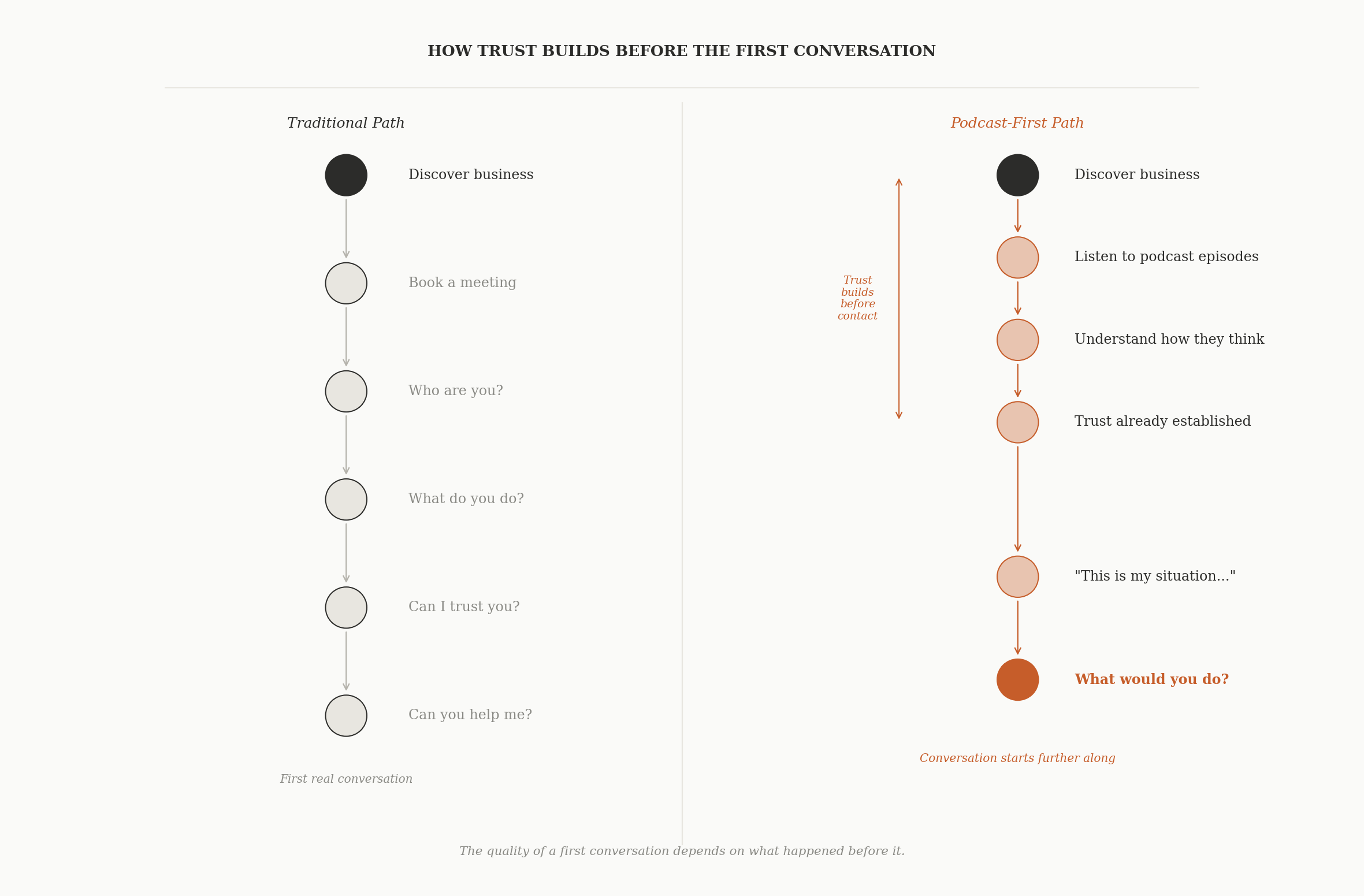
This plays out across industries. A livestock agent who records quarterly episodes about market conditions, property cycles, and how to prepare cattle for a sale doesn’t spend the first fifteen minutes of a new client call establishing credibility. An architect who talks through how they approach briefs, what goes wrong in renovations, and how they think about budget constraints has already answered the questions a new client would otherwise spend an hour asking.
The first call doesn’t disappear. It just starts further along.
Why Not Just Write Blogs Instead?
Blogs are useful. They’re searchable, indexable, and good for SEO. But a blog post and a podcast episode produce different results because they require different levels of engagement.
A blog post can be skimmed. A podcast can’t. Skimming gives someone information. Listening gives them something closer to an experience.
The other practical difference is that most business owners are better at talking than writing. A forty-minute conversation recorded on a Thursday afternoon can be edited into an episode, transcribed into a blog post, clipped into a LinkedIn video, and broken into a month of newsletter content. A blog post, by comparison, produces one blog post.
Blogs and podcasts work well together, but if the goal is building trust at scale, podcasting is doing more of the heavy lifting.
Couldn't I Just Post on LinkedIn?
You could, and it’s worth doing. But LinkedIn posts and podcast episodes are not competing for the same outcome.
A LinkedIn post can reach your existing network and occasionally go wider. It builds visibility. A podcast episode builds something closer to familiarity, and familiarity is what actually converts.
The businesses we see getting consistent results from LinkedIn are the ones already producing long-form content somewhere else. The posts work better because they’re drawing on a deeper well. A thirty-second clip from a podcast episode performs differently on LinkedIn than a text post written from scratch, because the clip is a fragment of something larger and the audience can sense that.
8 Assets You Can Create From One Recorded Conversation
This is the part most businesses don’t fully account for before deciding podcasting is too time-consuming.
One well-planned one-hour recording session can produce:
- Full-length podcast episode for audio platforms (Spotify, Apple Podcasts)
- Video episode for YouTube
- Short video clips for LinkedIn (30-90 seconds, 3-5 per episode)
- Instagram Reels and Facebook clips
- Long-form SEO blog article
- Newsletter feature or standalone issue
- Pull-quote graphics for social
- Website resource or FAQ content
- AI search-optimised written content
- Internal training or onboarding material
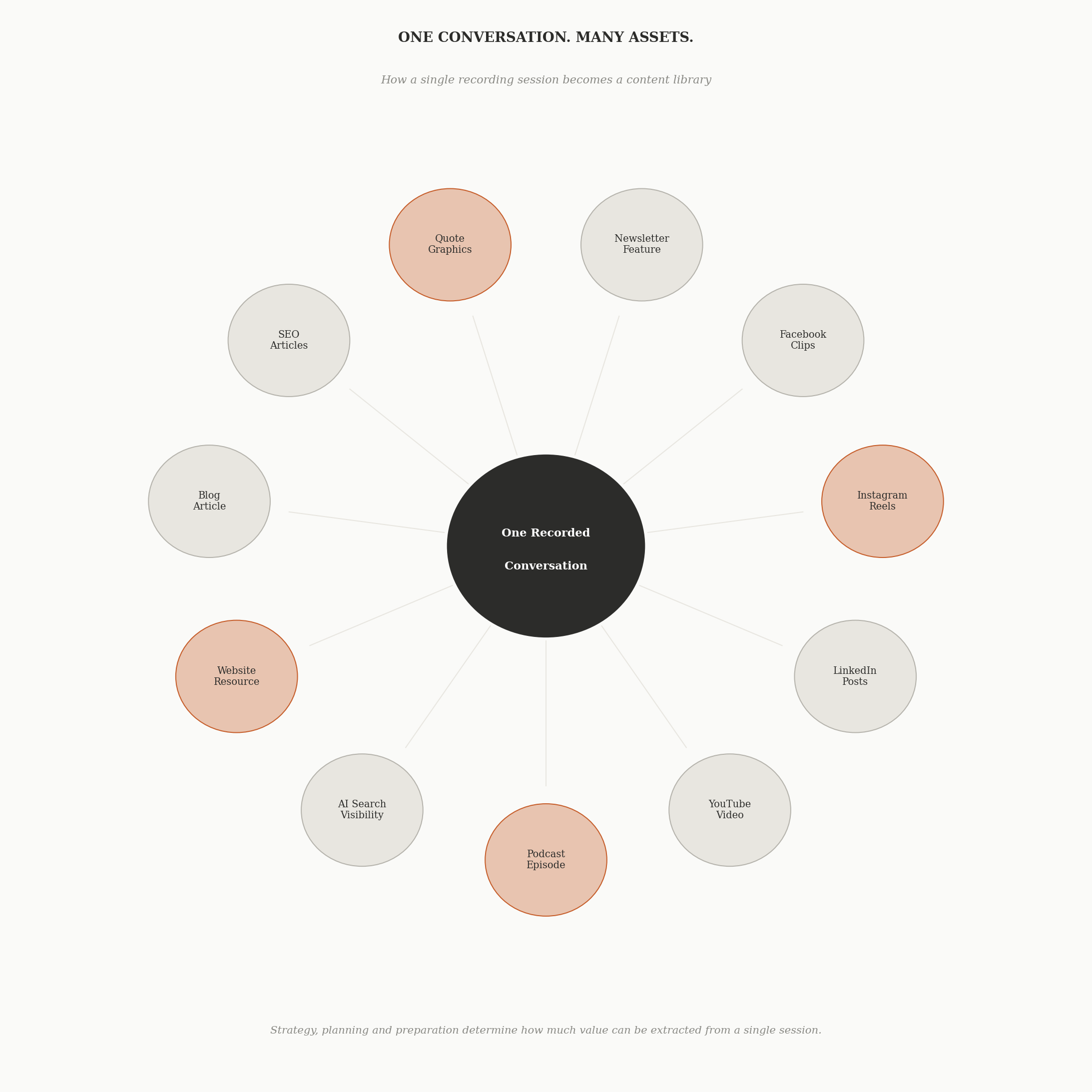
The caveat is that this doesn’t happen automatically. Getting ten formats from one conversation requires planning it well enough that it yields usable material across all those contexts. That’s why the strategic work before recording matters as much as the recording itself.
Why Long-Form Content Performs Better in AI Search
Google’s AI Overviews and tools like ChatGPT and Perplexity pull from sources that can answer questions clearly and in depth. A short social post can’t do that. A well-structured article that genuinely explains how business podcast production works can.
The question is no longer just whether something will rank on Google. It’s whether an AI assistant will quote it when someone asks about podcast strategy.
The answer depends on whether the content is:
- Authoritative (written from direct experience, not assembled from other sources)
- Structured (clear headings, tables, and frameworks that AI can parse)
- Complete (answers the full question rather than teasing it)
A well-produced podcast, properly converted into long-form written content, checks all three. A LinkedIn post checks none of them.
What Happens Before and After a Podcast Recording
Most people think about podcasting as: book a guest, record a conversation, publish the episode. The actual process, done well, looks like this:
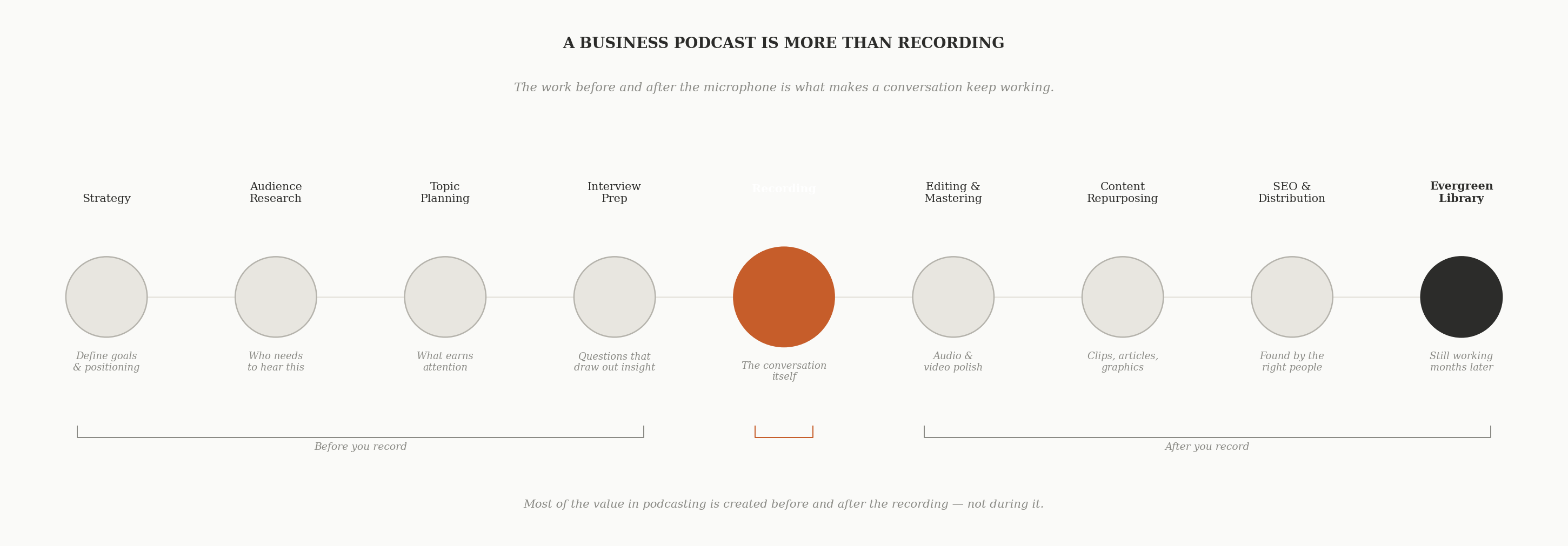
Before recording:
- Topic strategy — identifying what your audience is actually trying to understand, not just what you want to say
- Audience positioning — making sure episodes are built for the people most likely to become clients
- Interview preparation — structuring conversations to produce usable insight rather than rambling answers
- Host coaching — making sure the person on the microphone sounds like themselves, not a nervous version of themselves
After recording:
- Editing and audio mastering — removing dead air, fixing levels, making it listenable
- Video production — turning the recording into a visual format for YouTube and social
- Content repurposing — extracting clips, quotes, blog content and newsletter material
- SEO optimisation — making sure the content is findable by search engines and AI
- Distribution — getting it onto the right platforms and in front of the right audiences
The recording itself usually takes an hour. The work around it is what determines whether that hour produces six months of content or one episode.
Common Mistakes Businesses Make When Starting a Podcast
Starting without a strategy.
Deciding to do a podcast and then figuring out what to talk about is backwards. The most useful podcasts are built around the questions clients actually have, not the topics the business finds interesting.
Recording without a repurposing plan.
An episode that produces only an episode has a limited lifespan. An episode that produces an episode, three clips, a blog post, and a newsletter feature is a different investment entirely.
Treating quality as optional.
Bad audio is not a personality quirk. It’s a credibility signal. If the production quality suggests the business doesn’t care, the listener draws conclusions.
Stopping before it compounds.
Most podcasts that don’t work stopped too early. A library of twelve well-produced episodes performs very differently from a library of three. The value builds as new listeners find older episodes and content starts appearing in search results.
Not coaching the host.
Most business owners are articulate in conversation and stiff on the microphone. A bit of preparation before recording makes the difference between something that sounds authentic and something that sounds like a corporate video.
What RD Creative Studio Does
We handle podcast production end-to-end for businesses in Australia.
That means: strategy, topic planning, interview preparation, recording support, editing, audio mastering, video production, content repurposing, SEO, and distribution.
We work with businesses where the founder or senior team has significant expertise that isn’t currently reaching enough of the right people. The podcast becomes the vehicle. The repurposed content becomes the ecosystem around it.
If you’re thinking about this seriously, the most useful next step is a conversation about whether it makes sense for your specific situation.
Book a clarity call or reach out at projects@rdcreativestudio.com.au