The Difference Between AI-Capable and AI-Dependent Businesses
Consider two businesses in the same industry. Both have introduced AI across their operations over the past 18 months. Both use similar tools — AI for content, AI for customer communications, AI for reporting, AI to support their teams. Both would describe themselves as forward-thinking.
Twelve months from now, one of them will be measurably stronger. Faster decisions and more consistent output with less overhead.
The other will have quietly accumulated a different set of problems: processes nobody fully understands, inconsistent outputs, a growing dependence on individuals who know how to prompt things correctly, and a low-grade anxiety every time a tool changes its pricing or capabilities.
Same tools. Very different positions.
The difference isn’t which tools they adopted. It’s the architectural decisions made before, during, and after adoption.
Why AI Amplifies What's Already There
There’s a belief — understandable but misleading — that AI improves businesses by filling gaps. The logic goes: if our team is thin, AI can stretch them further. If our processes are inconsistent, AI can make them consistent. If we don’t have documentation, AI can help us generate it.
This is partly true. It’s mostly a trap.
AI amplifies existing structure. A business with clearly defined workflows and well-organised data will find that AI makes those things faster, more consistent, and more scalable. A business where processes exist primarily inside people’s heads will find that AI makes that opacity faster too — producing output at volume, without the underlying judgment that made the output worth having.
The tool doesn’t fix the foundation. It runs on it.
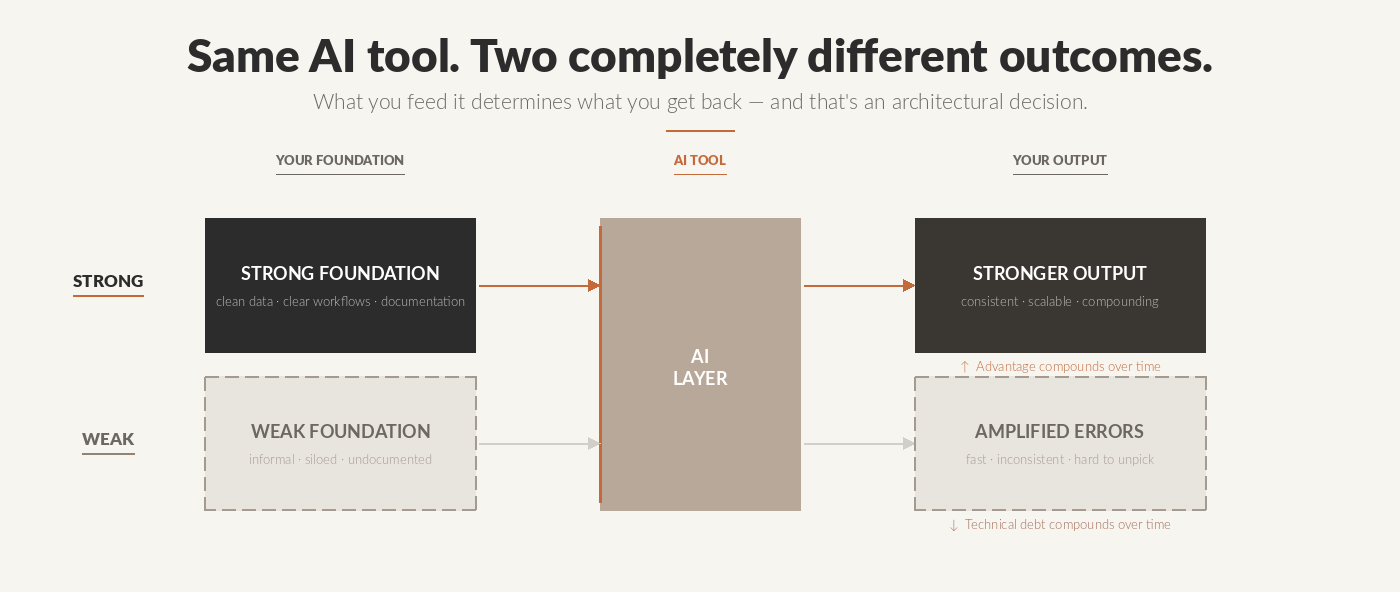
What Separates AI-Capable Businesses from AI-Dependent Ones
An AI-capable business uses AI to extend what it already does well. The humans understand the work. The AI accelerates it. When a tool changes, the team adapts because the underlying knowledge lives with them, not the software.
An AI-dependent business has transferred critical knowledge and judgment into AI systems without maintaining the underlying capability. Output depends on specific prompts, specific tools, or specific individuals who know how to operate the setup. When something breaks or changes, very little can continue without it.
| AI-Capable Business | AI-Dependent Business | |
|---|---|---|
| Knowledge ownership | Documented and distributed across the team | Held by individuals or locked in prompts |
| Decision making | AI-informed; humans own the judgment | Deferred to AI output; rarely questioned |
| Workflow consistency | AI follows a defined process | AI is the process |
| Documentation | Systems exist independently of AI | AI compensates for the absence of documentation |
| Data structure | Clean, organised, accessible | Fragmented, inconsistent, prompt-dependent |
| Team adaptability | Team can work with or without the tool | Team capability has quietly atrophied |
| Risk profile | Low — architecture doesn’t depend on one tool | High — tool or staff changes break operations |
| Operational resilience | Improves as systems mature | Degrades as dependency deepens |
| Compounding effect | Advantage compounds over time | Technical debt compounds over time |
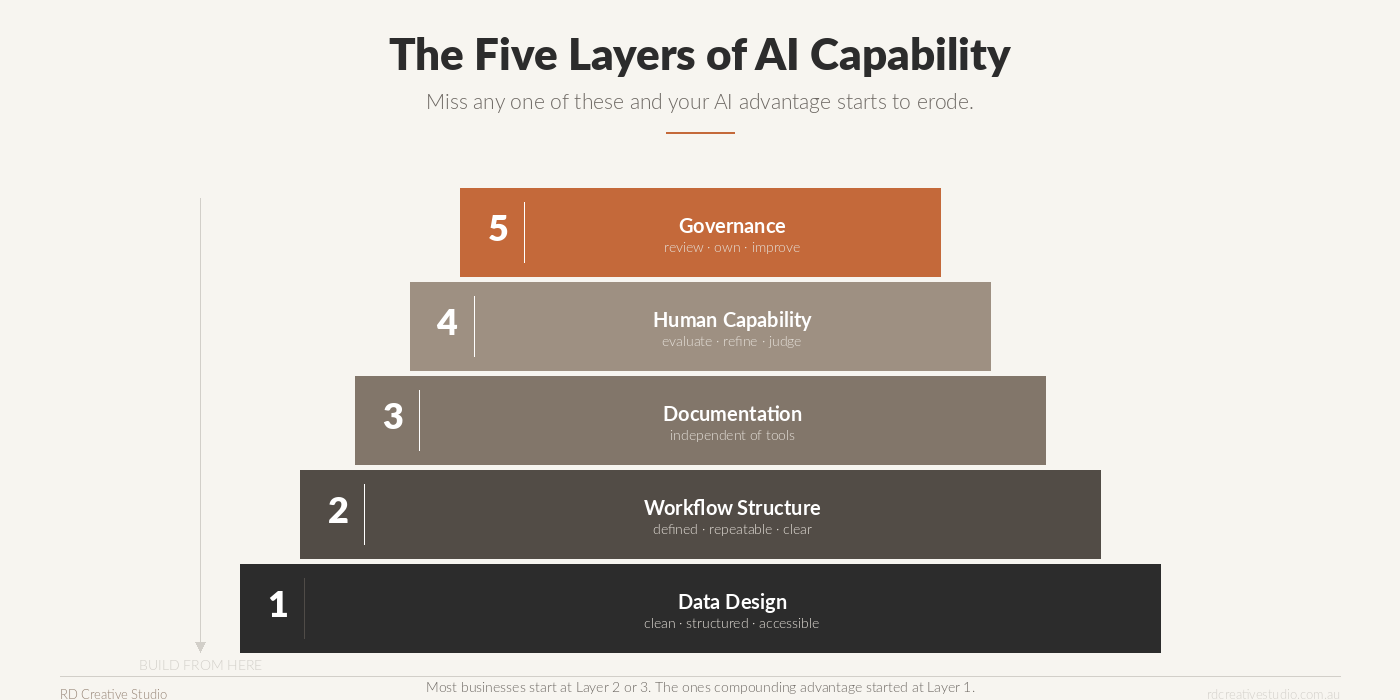
The Five Layers of AI Capability
AI capability isn’t a product of which tools you’ve adopted. It’s built across five distinct layers of organisational infrastructure.
Layer 1: Data Design
AI needs structured, accurate, accessible data to produce reliable output. Businesses that have invested in consistent data formats — clean CRMs, organised file structures, standardised naming conventions — find AI significantly more useful. Businesses feeding AI inconsistent or fragmented data get inconsistent or fragmented output. The AI isn’t failing. The data is.
Layer 2: Workflow Structure
AI should slot into a defined workflow, not become one. A well-structured workflow has clear inputs, clear steps, and clear outputs before AI enters the picture. When AI is introduced into that structure, it accelerates individual steps without collapsing the overall logic. When businesses skip workflow design and jump straight to AI, they get speed without direction.
Layer 3: Documentation
AI can assist with documentation. It can’t replace the decision to document. Businesses that document their processes, templates, standards, and decision criteria give AI something meaningful to work with — and give their teams something to maintain. Businesses without documentation are perpetually recreating context: for their staff, for their AI tools, and for anyone new who joins.
Layer 4: Human Capability
AI-capable businesses invest in their team’s ability to understand, evaluate, and improve AI output — not just generate it. When staff understand what good output looks like and why, they can catch errors, refine processes, and identify when AI is producing confident-sounding but inaccurate results. When staff have simply been trained to click buttons, quality erodes quietly.
Layer 5: Governance
This is the layer most businesses skip. Governance means: who reviews AI output before it reaches customers, what the quality standard is, how often systems are reviewed, and who owns the process. Without governance, errors accumulate silently. Small inconsistencies become embedded in templates, get replicated at scale, and become very difficult to unpick.
How AI Dependency Forms
No business deliberately builds AI dependency. It accumulates through decisions that each look reasonable at the time.
The marketing team discovers that one person is exceptionally good at prompting. Rather than documenting and distributing that knowledge, it centralises around them. When they leave, output quality drops and nobody can quite articulate why.
The operations team starts using AI to generate reports. The reports look clean. Over time, data hygiene receives less attention — because the output still looks fine. The inputs are getting noisier. The presentation hides it.
A new tool appears to offer better results than the current one. The team migrates without transferring what they’d learned — the prompt structures, the quality workarounds, the review steps. Six months later, the same thing happens again.
Each of these is a single reasonable-looking decision. Together, they create a business whose AI capability is fragile, person-dependent, and not improving over time.
What This Looks Like in Practice
Marketing team
AI is producing content at volume. The brief-to-output process, however, lives entirely inside one person’s head and a collection of conversation threads. There’s no documented brand standard, no prompt library, no review criteria. The team knows something occasionally feels off, but can’t articulate what — because the standard has never been written down. The AI is fast. The quality is inconsistent. Nobody’s sure whose job it is to address it.
Operations team
Reporting is faster than it’s ever been. But the data being reported on is entered inconsistently across the team, because nobody standardised input formats when the AI was introduced. The AI generates confident, clean-looking summaries of unreliable data. Decisions are being made against those summaries.
Customer support
AI handles first-response at scale. The underlying knowledge base hasn’t been updated in eight months, because the AI appeared to be managing. Customer complaints about incorrect information have increased. The AI is accurately reflecting outdated information.
Sales team
Proposals are generated quickly using an AI template. The template was well built initially and hasn’t been reviewed since. The messaging no longer reflects how the business has evolved. Prospects are receiving materials that don’t quite match the conversations being had.
None of these are failures of AI. They’re failures of architecture.
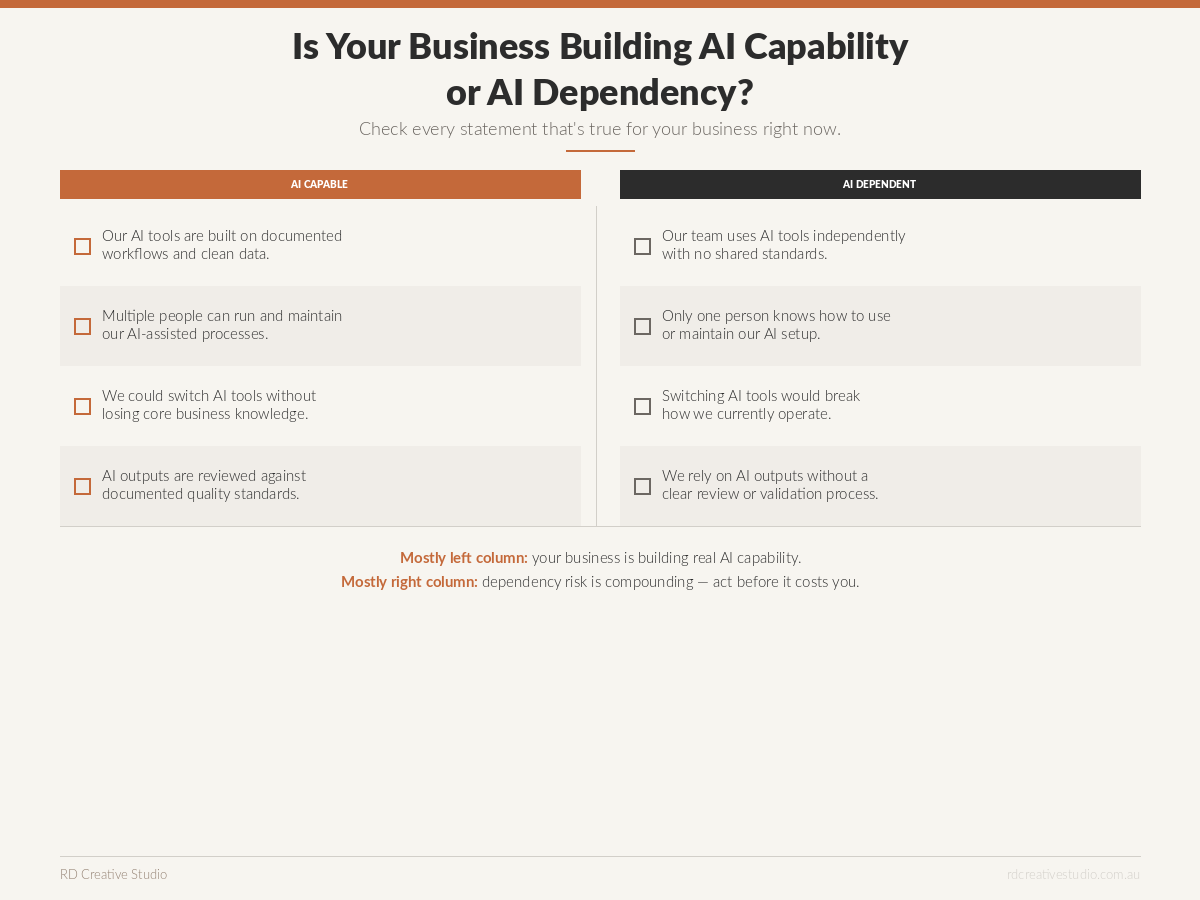
Questions Every Business Should Ask
Run through these with your leadership team. Be honest with the answers.
- Do our core workflows exist independently of the AI tools we use? Could we describe them clearly without referencing the tool?
- If our most AI-proficient team member left tomorrow, could the rest of the team maintain current output quality?
- Is our data — CRM, files, operational records — structured consistently enough that AI can work with it reliably?
- Do we have documented quality standards for AI-generated output? Is there a review step before that output reaches customers or stakeholders?
- Can we articulate clearly where AI adds value in our operations, and where humans retain decision-making authority?
- Has our AI setup been reviewed in the last six months — prompts, tools, outputs, quality standards?
- Do we have a prompt library or documented AI process that any team member could access and use?
- If the primary AI tool we rely on changed its pricing, capabilities, or terms significantly, what would break?
If more than three of these reveal gaps, the issue isn’t tool selection. It’s architecture.
Building AI Capability Over Time
The businesses that will be structurally stronger because of AI are the ones treating it as infrastructure, not software.
Software gets adopted and used. Infrastructure gets designed, maintained, reviewed, and improved. The distinction matters because it changes the decisions made around adoption. When AI is infrastructure, the questions shift: How should our data be structured to support this? What processes need to be defined before we automate them? Who owns quality? How does this compound over time?
These aren’t questions about which tool to use. They’re questions about how work should be organised.
The gap between AI-capable and AI-dependent businesses isn’t a technology gap. It’s an architectural one. And it’s widening quietly, in the background, while most attention stays fixed on which tools to adopt next.
The businesses compounding AI into genuine advantage made structural decisions early — around data, workflows, documentation, team capability, and governance — that most businesses are still treating as optional extras. Those decisions are not complex. They are, however, unglamorous enough that most businesses postpone them indefinitely.
The goal is a business that becomes more capable over time because of how it’s built — not one that becomes more exposed because of what it’s come to depend on.
If you’d like a second opinion on how your business is structured to use AI, book a clarity call with us. We look at operational architecture, not tools.

Frequently Asked Questions
What is the difference between an AI-capable and an AI-dependent business?
An AI-capable business uses AI to extend and accelerate existing, well-defined systems. The humans understand the work; the AI accelerates it. An AI-dependent business has transferred critical knowledge, judgment, and process into AI tools without maintaining the underlying capability in its people or documentation. When the tool changes, very little can continue without it.
What makes a business AI-capable?
AI capability is built across five layers: data design, workflow structure, documentation, human capability, and governance. Businesses that invest in these layers find that AI compounds into an advantage over time. Those that skip them find AI creates a new form of operational fragility.
How do SMEs avoid AI dependency?
By treating AI as infrastructure rather than software. This means designing workflows before automating them, documenting processes independently of the tools used to execute them, distributing AI knowledge across the team rather than centralising it, and reviewing AI systems regularly — not just when something breaks.
What are the five layers of AI capability in a business?
Data Design, Workflow Structure, Documentation, Human Capability, and Governance. Each layer must be in place for AI to produce reliable, scalable, and maintainable results over time.
How do I know if my business is building AI dependency without realising it?
Key indicators include: AI processes that only one person fully understands, no documentation of how AI is being used or reviewed, data that isn't consistently structured, no quality review step before AI output reaches customers or stakeholders, and uncertainty about what would happen if your primary AI tool changed significantly.